Exercise - Rapid Drawdown Analysis with XSLOPE
In this exercise, we will perform a rapid drawdown analysis on the Johnson Reservoir dam using XSLOPE. Rapid drawdown analysis requires a three-stage process that accounts for the change in pore pressures and strengths when the water level in a reservoir is lowered rapidly. For details on the methodology, see:
XSLOPE Rapid Drawdown Documentation
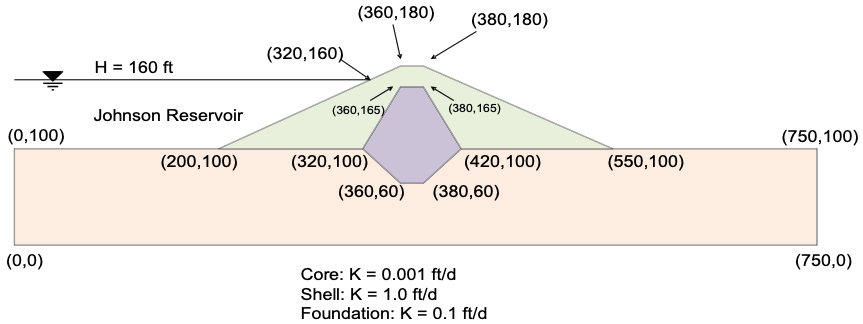
We will use the Johnson Reservoir dam for this exercise:
Step 1 - Prepare the Input File
Start with the following Excel input template that has been set up for a normal LEM analysis of the Johnson Reservoir dam. You can download the template here:
xslope_johnson_rapid_start.xlsx
The template includes the geometry of the dam, the profile lines, and the materials. It also includes a set of seepage boundary conditions for a normal LEM analysis (not rapid drawdown). We will modify the template to set up the rapid drawdown analysis.
Materials
The material properties are as follows. Note the addition of the \(d\) and \(\psi\) parameters for the shell and core materials. These are the undrained strength parameters used for the rapid drawdown analysis. Enter the \(d\) and \(\psi\) parameters shown below for the Core and Foundation. The shell material is assumed to be freely draining, so \(d\) and \(\psi\) are left blank.
| Material | \(\gamma\) (pcf) | Option | c' (psf) | \(\phi'\) (deg) | d (psf) | \(\psi\) (deg) |
|---|---|---|---|---|---|---|
| Shell | 130 | mc | 100 | 35 | ||
| Core | 125 | mc | 400 | 18 | 500 | 12 |
| Foundation | 127 | mc | 100 | 27 | 250 | 20 |
Make sure the pore pressure option (\(u\)) for each material is set to seep since we will be using seepage-derived pore pressures.
Verify that the seepage properties are set up for all 3 materials. They should match the following:
| Material | k1 | k2 | alpha | kr0 | h0 |
|---|---|---|---|---|---|
| Shell | 1 | 1 | 0 | 0.0001 | -1 |
| Core | 0.001 | 0.001 | 0 | 0.0001 | -1 |
| Foundation | 0.1 | 0.1 | 0 | 0.0001 | -1 |
Circles
Set up one or more starting circles for the upstream side of the dam (the side affected by rapid drawdown). The one in the starting template is a good option.
Distributed Loads
On the dloads sheet, set up two sets of distributed loads corresponding to the two pool levels. The distributed loads represent the hydrostatic pressure from the water on the upstream face of the dam.
Solution 1 - Full Pool: Calculate the distributed load for water at the full pool level (El. 160 ft). (This should already be set up for you. )
Solution 2 - Lowered Pool: Calculate the distributed load for water at the lowered pool level (El. 110 ft).
Seepage Boundary Conditions
On the seep bc sheet, set up two sets of seepage boundary conditions -- one for pre-drawdown (full pool) conditions and one for post-drawdown (lowered pool) conditions. XSLOPE supports two solutions on the seep bc sheet for this purpose.
Solution 1 - Full Pool (Pre-Drawdown):
- Upstream specified head: H = 160 ft (full pool level)
- Downstream specified head: H = 100 ft (free drainage at the downstream toe)
- Exit face on downstream slope
This should already be set up for you.
Solution 2 - Lowered Pool (Post-Drawdown):
- Upstream specified head: H = 110 ft (lowered pool level)
- Downstream specified head: H = 100 ft (free drainage at the downstream toe)
- Exit face on downstream slope
Step 2 - Run the Seepage Analysis
Upload your Excel input file to the XSLOPE seepage notebook and run the analysis. The notebook will generate two seepage solutions -- one for each set of boundary conditions. Use base_mat=3 when plotting the seepage solutions to focus the flow net cells on the foundation material.

After the seepage analysis completes, download the resulting zip archive. The archive contains the Excel input file, the mesh file, and both seepage solutions.
Step 3 - Run the Rapid Drawdown Analysis
Upload the zip archive from Step 2 to the XSLOPE LEM notebook. The notebook will automatically detect the two seepage solutions and use them for the three-stage rapid drawdown analysis.
Review the results. The notebook will report factors of safety for each stage of the rapid drawdown analysis:
- Stage 1: Pre-drawdown stability using drained strengths and full pool pore pressures
- Stage 2: Post-drawdown stability using interpolated undrained strengths
- Stage 3: Post-drawdown stability check using drained strengths
The critical factor of safety for rapid drawdown is the minimum of Stages 2 and 3.
Solution: xslope_johnson_rapid_KEY.zip