Homework - Darcy's Law
Solve the following problems using Excel or Google Sheets. Show all of your work and calculations.
-
The water level in an observation well A is measured at 3785.4 ft. At a point 1238 ft downgradient from that point, the water level in a second well (B) is measured at 3629.3 ft.
a) What is the hydraulic gradient between the well A and well B?
b) Assuming that the hydraulic conductivity is 3.0 ft/day and the effective porosity is 0.3, what is the seepage velocity between the two points? [ft/day]
c) How long would it take for a particle to travel from point A to point B? [days]
-
The figure below shows a pressurized reservoir with the water level at point A. The discharge is into the atmosphere at point C. The connecting pipe is of constant diameter with a cross-section of 0.02 m^2 and is filled with a sand with hydraulic conductivity of 0.015 m/s. The average length of the pipe is 9.0 m. Point B is exactly halfway along the length of the pipe. The discharge at C is 0.0001 m3/s.
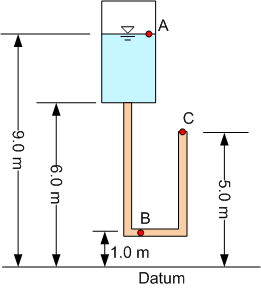
Compute the following:
a) The head loss from A to C.
b) The total head at A.
c) The pressure head at A.
d) The total head at B.
e) The pressure head at B
f) Is there flow from a region of low pressure to a region of high pressure? Where and why?
-
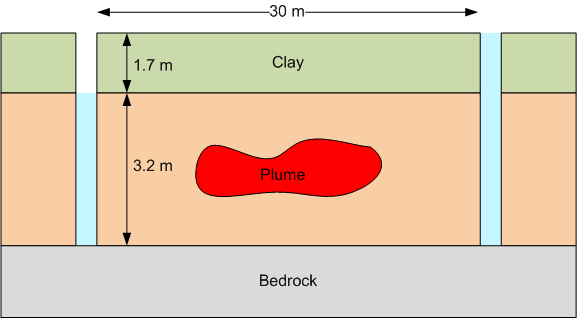
At a site owned by Company X, it is decided to remediate a plume using a double trench system as shown below. A plume lies between the two trenches in a sand layer that is capped by a relatively impermeable clay layer. Nutrient and oxygen-laden water will be injected in the trench on the right. The water will flush from right to left and be pumped out of the left trench. To ensure maximum biodegradation, it is best if the sand layer stays saturated. Thus, the trench on the left will be pumped just enough to keep the sand layer saturated. The trench on the right will be kept as full as possible. For the sand layer, assume than n = 0.35 and k = 0.01 cm/s.
a) For a one meter thick slice of the sand layer, how much water would need to be pumped to flush through one pore volume**?
b) How long would it take (in days) to pump 5 pore volumes of water through the sand?
** A pore volume is a common term used in analysis of site remediation projects involving flushing. A pore volume is defined as the total volume of the voids in the region being flushed. So when you flush "five pore volumes" it means that you have flushed enough water to displace all the water in the voids five times. To find the pore volume, calculate the total volume of the region being flushed and multiply by the porosity.
Submission
Save your work in a file named darcy_hw.xlsx and upload it on Learning Suite.
Grading Rubric
Total: 30 points
| Criteria | Points |
|---|---|
| Problem 1a: Hydraulic gradient | 2 |
| Problem 1b: Seepage velocity | 2 |
| Problem 1c: Travel time | 2 |
| Problem 2a: Head loss from A to C | 2 |
| Problem 2b: Total head at A | 2 |
| Problem 2c: Pressure head at A | 2 |
| Problem 2d: Total head at B | 2 |
| Problem 2e: Pressure head at B | 2 |
| Problem 2f: Flow analysis and explanation | 3 |
| Problem 3a: Pore volume calculation | 3 |
| Problem 3b: Time to flush 5 pore volumes | 3 |
| Documentation and work shown clearly | 5 |