Exercise: Finite Element Slope Stability Analysis
In this exercise, we will re-analyze four problems from earlier in the course using the Shear Strength Reduction Method (SSRM) with finite elements. For each problem, start with the XSLOPE input file from the corresponding LEM analysis and add Young's modulus (\(E\)) and Poisson's ratio (\(\nu\)) for each material. Use the values in the tables below, which are based on the typical elastic parameters discussed in the FEM Overview.
For each problem, run the analysis using both the LEM and FEM notebooks so you can compare the results side by side. The LEM notebook ignores the elastic properties, so you can prepare the complete input file with \(E\) and \(\nu\) first and then upload the same file to both notebooks.
LEM Notebook: 
FEM Notebook:
For each problem, run the LEM notebook first to get the LEM factor of safety. Then use that result to select appropriate values of \(F_{min}\) and \(F_{max}\) for the SSRM bisection in the FEM notebook. The FEM factor of safety is typically close to but slightly higher than the LEM result, so a good approach is to set \(F_{min}\) about 0.2 below the LEM result and \(F_{max}\) about 0.4 above. Note how the FEM method naturally reveals the failure mechanism through shear strain concentrations without requiring a prescribed failure surface.
Problem 1 - Simple Slope with Foundation
This is the same problem from XSLOPE Class Exercise 1, Problem 2.
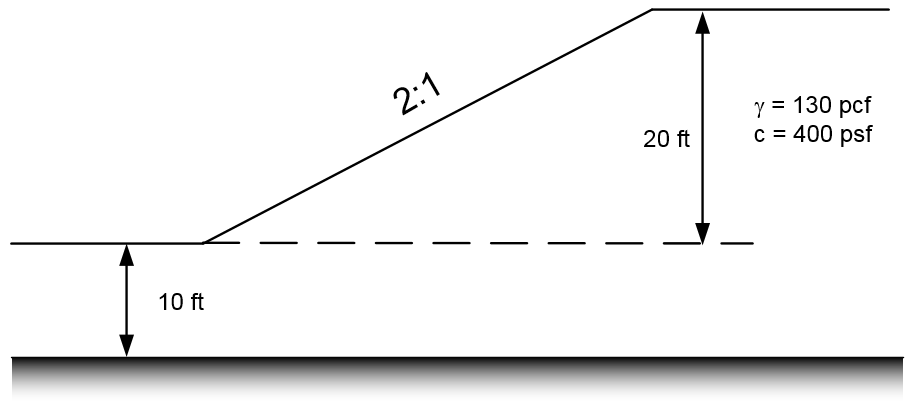
Start with the LEM solution file and add the following elastic properties:
| Material | \(E\) (psf) | \(\nu\) |
|---|---|---|
| Embankment/Foundation (\(c\) = 400 psf, \(\phi\) = 0) | 150,000 | 0.40 |
Since this is an undrained (\(\phi = 0\)) material, a Poisson's ratio of 0.40 is used rather than the theoretical undrained value of 0.5 to avoid numerical issues with near-incompressibility. The modulus is estimated as \(E/S_u \approx 375\).
Starter template: xslope_simple_foundation.xlsx
Add \(E\) and \(\nu\) to the starter template and upload the file to both notebooks. Compare the two factors of safety and note the shear strain plot showing the failure mechanism.
Solution: xslope_simple_foundation_KEY.zip
Problem 2 - Slope with Multiple Layers
This is the same problem from XSLOPE Class Exercise 1, Problem 3.
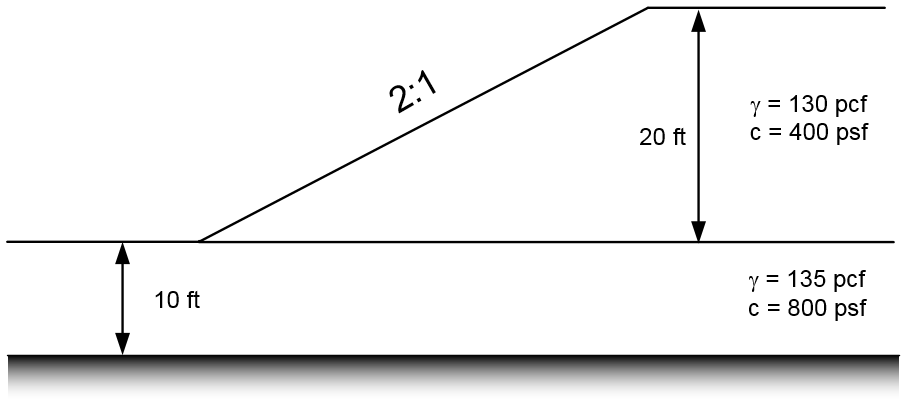
Start with the LEM solution file and add the following elastic properties:
| Material | \(E\) (psf) | \(\nu\) |
|---|---|---|
| Upper (\(c\) = 400 psf, \(\phi\) = 0) | 150,000 | 0.40 |
| Lower (\(c\) = 800 psf, \(\phi\) = 0) | 300,000 | 0.40 |
Both layers are undrained (\(\phi = 0\)) with \(E/S_u \approx 375\) and \(\nu = 0.40\).
Starter template: xslope_simple_mult_layers.xlsx
Add \(E\) and \(\nu\) to the starter template and upload the file to both notebooks. Compare the factors of safety and the location of the critical failure surface.
Solution: xslope_simple_mult_layers_KEY.zip
Problem 3 - Reinforced Slope with Geogrid
This is the FEM version of the problem from the Reinforced Slopes Exercise. For additional details on how reinforcement is modeled using truss elements in the FEM method, see the XSLOPE Soil Reinforcement documentation.
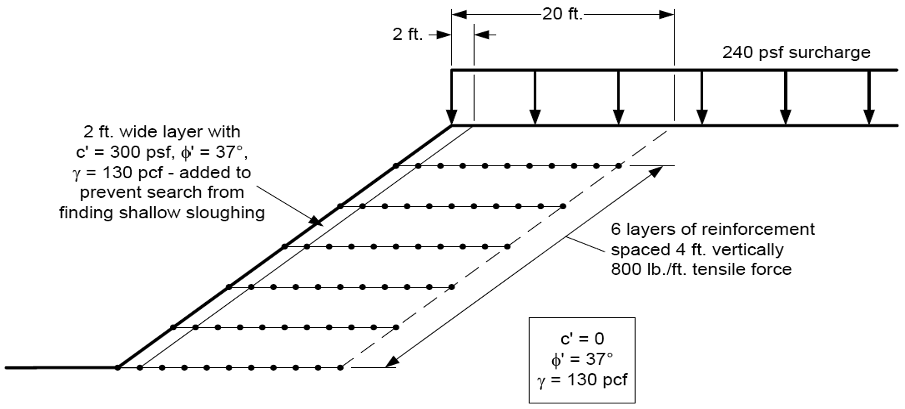
Start with the LEM solution file and add the following elastic properties for the soil materials:
| Material | \(E\) (psf) | \(\nu\) |
|---|---|---|
| Shell (\(c\) = 300 psf, \(\phi\) = 37°) | 1,000,000 | 0.3 |
| Base (\(c\) = 0, \(\phi\) = 37°) | 1,000,000 | 0.3 |
In the LEM analysis, the reinforcement was defined using the tensile strength and pullout length. The FEM analysis requires additional properties for each reinforcement line to model the stiffness and post-yield behavior of the geogrid elements. The following table summarizes the additional FEM reinforcement properties:
| Property | Description | Value |
|---|---|---|
| \(T_{res}\) | Residual tensile force after yielding | 600 lb/ft |
| \(E\) | Modulus of elasticity of reinforcement | 800,000 psf |
| \(Area\) | Cross-sectional area of reinforcement | 0.1 ft\(^2\)/ft |
The product \(EA\) = 10,000 lb/ft is the axial stiffness of the geogrid. Any combination of \(E\) and \(Area\) producing the same \(EA\) will give identical results. The residual strength \(T_{res}\) controls the post-yield behavior -- after an element exceeds \(T_{max}\), its capacity drops to \(T_{res}\) rather than failing completely. This peak-residual model is appropriate for ductile materials like geosynthetics.
Starter template: xslope_reinforce.xlsx
Add \(E\), \(\nu\), and the reinforcement properties above to the starter template and upload the file to both notebooks. Compare the factors of safety and examine the reinforcement summary table to see which elements have yielded or pulled out.
Solution: xslope_reinforce_KEY.zip
Problem 4 - Earth Dam with Seepage
This problem applies the FEM method to the earth dam from the Seepage/Slope Integration Homework. Unlike the previous problems, this analysis includes seepage-derived pore pressures that affect the stability results.
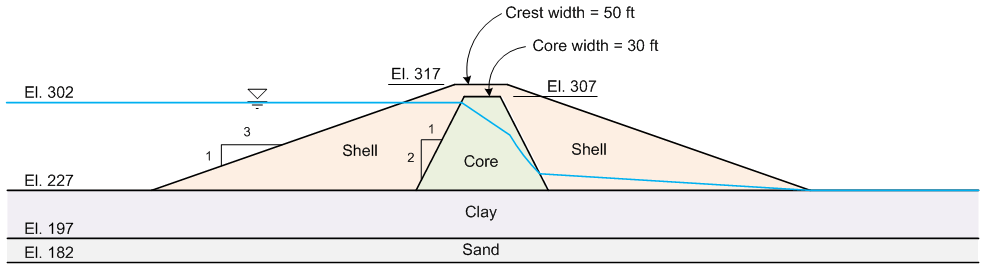
A starter zip archive is provided that includes the Excel input file with the dam geometry, strength properties, seepage material properties, and seepage boundary conditions already set up. The archive also includes the seepage solution (mesh and pore pressures) so you do not need to run the seepage analysis again.
Start with the starter template and add the following elastic properties:
| Material | \(E\) (psf) | \(\nu\) |
|---|---|---|
| Shell | 700,000 | 0.30 |
| Core | 300,000 | 0.35 |
| Clay | 200,000 | 0.35 |
| Sand | 1,000,000 | 0.30 |
Starter template: xslope_earth_dam_fem.zip
Add \(E\) and \(\nu\) to the input file, re-zip it with the mesh and seepage solution files, and upload to both the LEM and FEM notebooks. For the LEM analysis, run the downstream side using Spencer's method. For the FEM analysis, use \(F_{min} = 1.0\) and \(F_{max} = 1.4\) based on the LEM result with a piezometric line (FS \(\approx\) 1.2). Compare the LEM and FEM results and note whether the FEM finds the same localized toe failure or reveals a different failure mechanism. Also note that the FEM does not require you to specify which side to analyze -- it naturally finds the critical failure mechanism.
Solution: xslope_earth_dam_fem_KEY.zip